
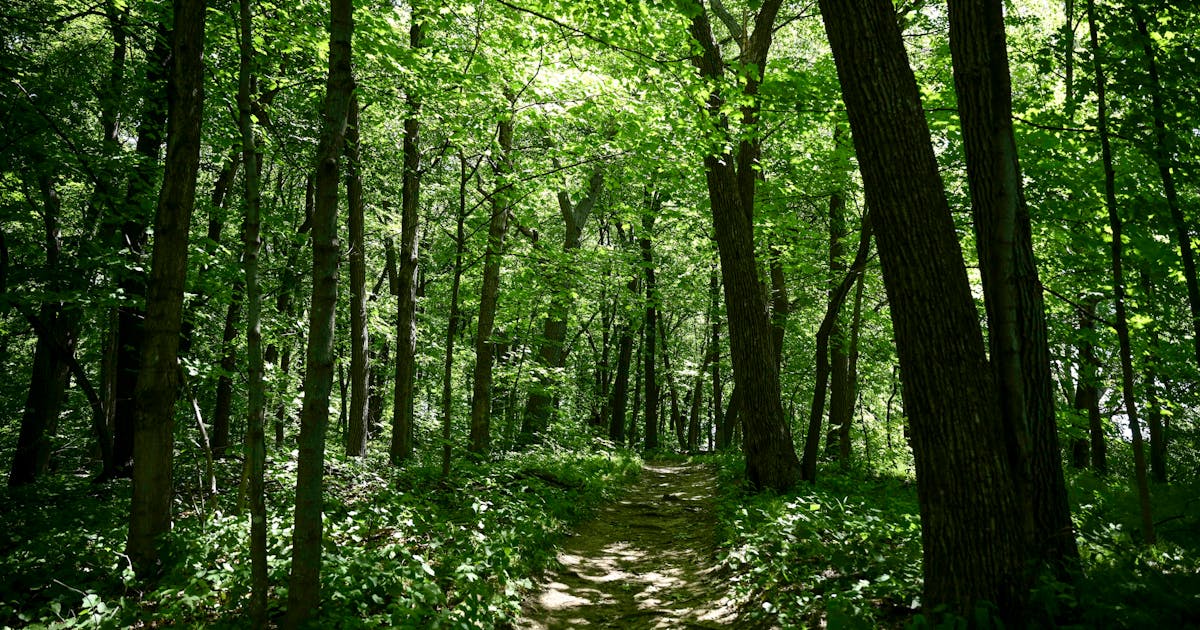
Minnesota’s great basswood and sugar maple forests have been cut into smaller and smaller pockets over the past 150 years. The “Big Woods” that once ruled the state are long gone, fractured into hundreds of parks and preserves.
There are still vestiges of the old forest that have never been exploited, or at least have not been exploited for a century. But they’re separated from each other by highways, houses and farms, and it’s unclear which plants and animals are still able to reproduce and which are on the verge of extinction.
University of Minnesota foresters begin a long-awaited tally, aimed at identifying every plant in what remains of the Big Woods of south-central Minnesota. Over the next two years, they will discover where some of the rarest plants, such as trilliums, still live and see if there are ways to bring back plant life.
“We start with the plants because if the plants are gone, then the pollinators are gone, and the whole ecosystem is gone,” said Lee Frelich, director of the U’s Center for Forest Ecology. “Think of a city with all these big buildings that are empty of people. You can still have old trees surviving, but without anything else, everything is degraded.”
The Big Woods are what explorers first called the shady forests dominated by elm, basswood, red oak, and sugar maples that once lined the edge of the Minnesota prairies. Prior to European settlement, the woods covered approximately 1.3 million acres in what is now the Twin Cities and south-central Minnesota. About 28,000 acres remain, or about 2%, Frelich said.
Although these remnants have been carefully protected in state parks and scientific preserves, many species may need more space to regenerate.
Many plants depend on insects to pollinate. When forests are separated from each other by farms and housing estates, it can be difficult, if not impossible, for these pollinators to travel from one patch to another, Frelich said.
Major stresses on forests have also worsened in recent decades, he said.
Invasive earthworms eat much of the humus and dead leaves on the forest floor, leaving more bare soils with fewer nutrients. High and dense deer populations ravaged some of the young plants and seedlings before they had a chance to develop. Climate change has made some pests worse and caused more flooding, which has become more damaging due to the way earthworms have disturbed the soil, Frelich said.
“When you lose that understory of plants, the antlers can’t function because the nutrients just keep going,” he said. “Without the nutrients, the whole system becomes ‘drier’; even if you don’t lose species entirely, they don’t grow as tall or as abundantly.”
Frelich will be aided by a team of citizen experts from the Minnesota Native Plant Society, who will help locate and document the plants. The U has records and seed banks going back 150 years, so researchers should be able to get a pretty good idea of what species existed before Europeans arrived.
The research will be funded by the state’s Environment and Natural Resources Trust Fund.
The hope is that the findings will help forest managers bring certain species back, whether by planting seeds by hand, moving pollen from one park to another or hiring snipers to reduce populations. of deer, Frelich said.
“If you want to solve a problem, you have to know what it is,” he said.
The results will be extremely useful to forest managers around the Twin Cities metro, said John Moriarty, senior director of wildlife at Three Rivers Park District.
Three Rivers has kept pieces of the Big Woods alive, such as Elm Creek, Lake Rebecca, Carver, and Baker parks. The park district tried to reconnect pockets of forest to each other whenever it could, Moriarty said.
“Most birds that live in maple or linden forests can fly among themselves, but when you think of small mammals, salamanders, frogs, and turtles, they cannot jump from one to the other. another,” Moriarty said. “Trillium seeds are moved by ants, and ants don’t travel far. So when you have a road between two pieces of wood, that’s a problem.”
