

Sunbirds are very important in an ecosystem because they pollinate flowers. Credit: Maximilian Vollstädt
Micro-organisms, plants and animals perform great feats every day. For example, by breaking down materials, producing plant biomass or pollinating flowers, they keep nature “in working order”, thereby ensuring human sustenance. Many studies have shown that high biodiversity can have a positive impact on these and other ecosystem functions.
“But there is another important factor at play. If the environmental conditions of an ecosystem are heterogeneous, for example in terms of soil properties and climate, this could give an additional boost to the positive effect of the biodiversity on ecosystem functions,” says Dr. Jörg Albrecht from the Senckenberg Center for Biodiversity and Climate Research.
Together with other researchers, Albrecht investigated whether the degree of environmental heterogeneity influences the positive effect of biodiversity on ecosystem functions. To this end, the researchers analyzed data from 13 natural and man-made ecosystems on Africa’s highest mountain, Mount Kilimanjaro. This is one of the first studies to investigate such a question in real ecosystems along an elevation gradient of more than 3500 meters.
“The data show that the positive effect of biodiversity on ecosystem functions is about 20% greater in a heterogeneous environment,” says Albrecht, and he continues: “This means that if the global trend towards If land use intensification continues, the positive effect of biodiversity on ecosystem functions could be diminished.
In addition, the researchers examined which aspect of biodiversity is more beneficial for the provision of ecosystem functions: changes in species richness or species turnover, i.e. changes in the composition of species along the altitude gradient. It has become evident that species richness plays a more important role in ecosystem functions than species turnover.
“Frankly, this surprised us, because in theory it was assumed otherwise. Moreover, the species communities of the savannah at the foot of the mountain are completely different from those of the cloud forests or the alpine summit. So “, the turnover of species is very high. In contrast, species richness, i.e. the number of species that co-exist in an ecosystem, changes to a lesser extent, but is much more important for the functioning of the ecosystem”, explains Dr Marcell Peters from the University of Würzburg.
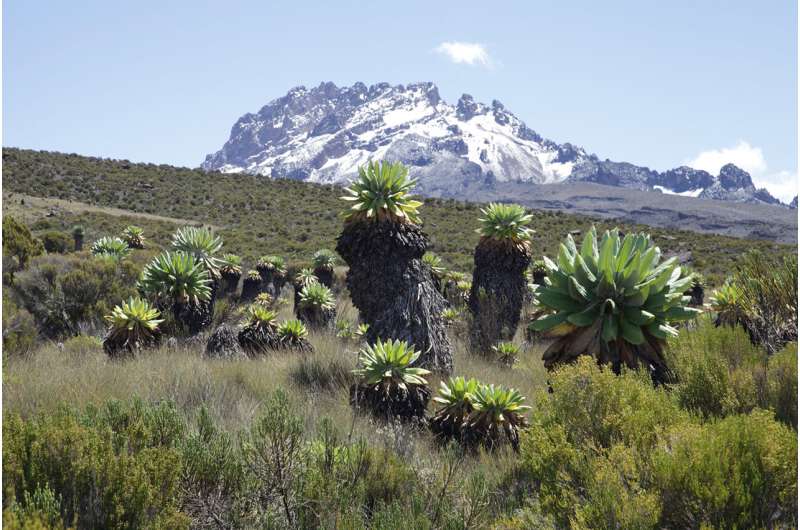
Ecosystem with alpine vegetation at Mount Kilimanjaro. Credit: Andreas Hemp
The researchers consider the findings to be proof that regional conservation efforts should focus on preserving species richness. “Our results confirm that biodiversity is not only important at small scales as demonstrated in experiments, but that these effects become even stronger in real landscapes at large scales. We were thus able to show that the protection of biodiversity is not a luxury, but essential for maintaining functioning ecosystems,” concludes Peters.
New Zealand fossils show more species lived in warmer waters, but current warming trends could break that pattern
Jörg Albrecht et al, species richness is more important for ecosystem functioning than species turnover along an elevation gradient, Nature ecology and evolution (2021). DOI: 10.1038/s41559-021-01550-9
Provided by the Senckenberg Research Institute and the Museum of Natural History
Quote: Diversity Matters: Species Richness Keeps Ecosystems Going (2021, September 24) Retrieved February 12, 2022, from https://phys.org/news/2021-09-diversity-species-richness-ecosystems.html
This document is subject to copyright. Except for fair use for purposes of private study or research, no part may be reproduced without written permission. The content is provided for information only.
