
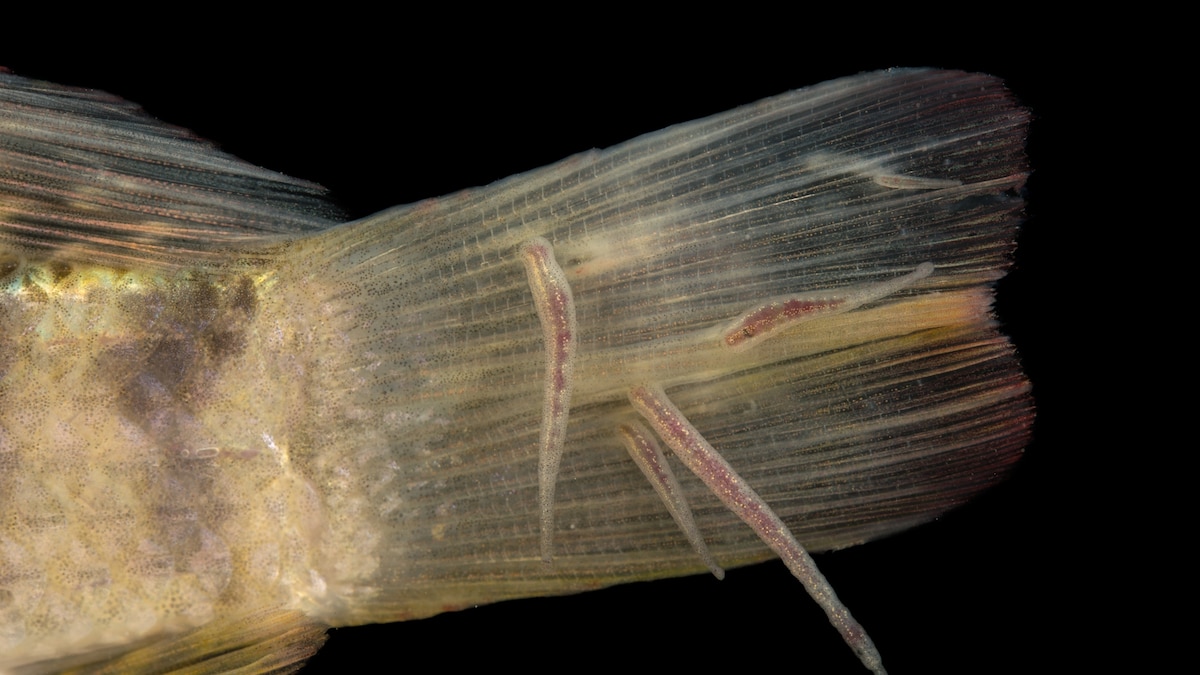
Many people are completely repelled by parasites, and few would intentionally share their bodies with one. The word “parasite” alone – which comes from the Greek for “to feed on the side” – is enough to give you goosebumps.
But parasitism deserves more respect as an “exceptionally successful form of life,” says Jimmy Bernot, an evolutionary biologist at the Smithsonian National Museum of Natural History in Washington, D.C. Animals, plants, fungi, bacteria and viruses can all be parasitic, from vampire bats to deep-sea anglerfish, whose tiny males permanently attach themselves to females.
Parasitism is a form of symbiosis, a close relationship between two organisms. While some parasites, called parasitoids, are deadly to their hosts, many do not cause major problems. Others will even protect their hosts from other parasites, such as viruses that protect bacteria against antibiotics. Bad news if you take penicillin, good news for the little pathogen.
Parasites draw nutrients from their hosts in a variety of ways: Some, called ectoparasites, literally drink the blood or eat the skin of their hosts. Others, called endoparasites, settle inside their hosts, such as tapeworms or botflies. (Read about a mind-controlling parasite that makes baby hyenas more reckless around lions.)
There are no solid estimates of how many parasite species exist in the world, but some experts believe that there are many more parasite species than “free-living” animals and that the majority of the parasites have probably not yet been discovered.
Given that parasites have intruded into every corner of life, it’s no surprise that their strategy has been around for a long, long time. The first parasite-host interaction in the fossil record was a worm stealing food from a clam-like brachiopod 515 million years ago.
“When we develop food webs or ecological webs, we find in some cases that parasites make up more than half of the links between species,” says Mackenzie Kwak, a parasitologist at the National University of Singapore. “So if you want to find the glue that ties these ecosystems together, it’s the parasites.”
Beyond the leeches
Leeches, a type of worm, may be the most well-known parasites. There are 700 species, but only about half of them suck blood. They live everywhere on Earth except terrestrial Antarctica, but the oceans around the polar continent have leeches with tentacles that look like dirty fingers.
Parasites can get even more resourceful than that. Take toads, which prefer to live in the nostrils of amphibians, or tongue-eating lice, sea creatures that latch onto a fish’s tongue, one of the rare examples of a parasite literally replacing the organ of a host.
In addition to living off their hosts, the parasites have adapted ways to sterilize them, hijack their immune systems, or even hijack their behavior. Some Cordyceps fungi, for example, turn their insect hosts, such as ants, into “zombies”, forcing them to climb above the ground – a perfect place to disperse the fungus’s spores – before killing them. The spores fall to the ground, landing on a new bug before the cycle continues. (Read more about “zombie” parasites.)
Some parasites steal resources indirectly. Take the common cuckoo, a brood parasite that freeloads itself on other organisms to raise its offspring. By laying its eggs in another bird’s nest, it forces the bird to raise the baby cuckoos itself.
Small but mighty
Some pests, although small, can have gigantic effects on their ecosystems. The humble yellow rattle, Rhinanthus minor, is a parasitic plant native to Europe that slips its roots into grasses and drinks them dry.
“Essentially, when you don’t have a yellow rattle in your wildflower meadows, they revert back to meadows,” Kwak explains. “When you have a yellow rattle, it weakens those hyper-competitive grasses and then you get all of this wonderful diversity of flowers in your wildflower meadow.”
By replacing grasses with wildflowers, the yellow rattle also makes room for pollinating insects, which in turn attract birds and amphibians. (Learn how to help pollinators at home.)
“They actually build the foundation that supports the whole wildflower meadow and helps keep these sensitive wildflowers from being overtaken,” Kwak says.
pests of pests
When a parasite is a parasite of a parasite, it’s called a hyperparasite – and it’s actually quite a common occurrence. Take the Parasitic Wasp Hyposoter horticolawhich is parasitized by Mesochorus cf. stigmaticanother wasp that lays its eggs in the H. horticola wasp larva.
In some rare cases, there may even be a hyperhyperparasites, like a fungus on a fungus on a fungus on a tree. In New Zealand, the fungus Rhinotrichella globulifera eats the dead parts of the mushroom Hypomyces cf aurantius, which in turn eats the fungus from the bracket Hemitephrus of Fomeswhich colonizes beeches.
Save the Bloodsuckers
Despite their importance, parasites are “strangely overlooked,” says Jessica Stephenson, an assistant professor at the University of Pittsburgh who studies evolutionary parasitism.
For example, conservation programs often overlook these organisms. In many ways, parasites are more at risk than other organisms, including from climate change. First, there are the direct effects of rising global temperatures, which in the past have caused several mass extinctions. But if a single host of multiple parasites goes extinct, it could wipe out multiple parasite species in one fell swoop.
“Given their hyperdiversity, this could mean that parasites represent the majority of species at risk of extinction,” Kwan and his co-authors wrote in a 2020 study that calls for a “global parasite conservation plan.” The document outlines several ways to protect parasites, such as listing them as protected species.
“Almost every endangered animal I look at, I find co-threatened parasites, many of which are new species,” Kwak says.
For example, he was among the first to document the endangered pangolin tick (Amblyomma javanense), which lives on the critically endangered Sunda pangolin in Southeast Asia. He also gave the common name to one of Australia’s rarest parasites, the goblin flea, (Stephanocircus domrowi), so named because it lives on the critically endangered fairy opossum.
Importantly, these conservation efforts do not apply to human or livestock parasites, such as Guinea worm, which causes a wasting disease in which the worm emerges from a person’s skin, according to the study.
But in many other cases, Kwak says, “these species don’t necessarily harm their hosts. They are just passengers on this long evolutionary journey… and it is worth protecting them for the integrity and stability of the ecosystem.
